
- 19th June, 2018
When an Algorithm is in the Dock
By Ekow Duker
The age of criminal responsibility is used to determine the ‘physical capacity of a child to commit a crime.’ Some crimes are thought to require a certain level of maturity and as such, children who fall foul of the law in this way, are not usually regarded as adults.
The age of criminal responsibility varies from country to country. It ranges from 8 years in Antigua and Barbuda to 18 in Colombia. South African law presumes that a child less than 14 years of age lacks criminal capacity, while in the United States, the minimum age of criminal responsibility for federal crimes is 11.
Establishing criminal capacity for an infant is difficult enough. The complexity of the issue becomes much greater when the offender is an algorithm.
Certain classes of machine learning algorithms - and specifically neural networks - are ‘black boxes’ by design. In a sense, these algorithms alter their internal structure a dizzying number of times as they churn their way towards a solution. And while the answer might be startlingly accurate, it is practically impossible to explain without a hefty dose of hand waving, exactly how the algorithm arrived at the solution.
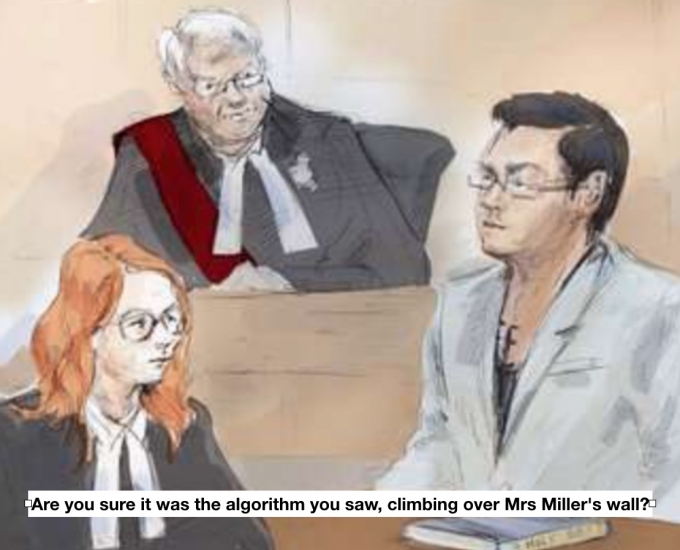
This gives rise to interesting conundrums in law. Can an algorithm, or its maker for that matter, be called upon to testify in court, if neither of them can give cogent answers under cross examination? Questioning an algorithm in this way could be as futile as interrogating a little child. For this reason, France’s digital-economy minister, Mounir Mahjoubi, has said that the French government should not use any algorithm whose decisions cannot be explained.
There are other machine learning methods such as decision trees that lend themselves more easily to explanation. These are useful in credit applications for example, where it is desirable or even mandatory, to be able to explain how a decision was arrived at. However the vast range of applications that machine learning and AI are starting to impact, makes a confrontation between an algorithm and a court of law, almost inevitable.


